
Call-out fee: $80–$180
What most Sydney plumbers charge to attend. Ask for it on the phone. Anyone who will not name it is telling you something.
Genuine round-the-clock cover across Erskineville. You get an honest ETA rather than a flattering one, a fixed price before work starts, and on the calls that can safely wait, you get told that too.
The honest test is whether it is still getting worse while you wait. Water, waste or gas going somewhere it should not, and not stopping. A burst pipe, sewage backing up into the shower, a hot water tank emptying through the ceiling, or any smell of gas: those are emergencies, and waiting until morning multiplies the damage bill.
Then there is the category people apologise for calling about: the only toilet in the house blocked, no hot water with a newborn, a drain backing up the night before an inspection. Call anyway. An after-hours call here reaches a plumber, not a promise of one tomorrow.


Terraces off Erskineville Road and Swanson Street still run 130-year-old clay lines whose cracked, offset joints are the suburb’s number-one blockage source.
A drainage system laid a century ago was built for a household that used a fraction of the water yours does. Add a second bathroom, a dishwasher and a washing machine, and lines that coped for decades start showing where they are weakest.
That is not an argument for replacing everything. It is an argument for knowing which sections are actually tired, so the money goes into those rather than into the whole run on the assumption that old means finished.
Around Erskineville we work with premises where closing for a day is not a small inconvenience — it is the week's takings and a shift's wages.
Erskineville is a tight-knit Inner West village (postcode 2043) of Victorian workers’ terraces and converted industrial sites, bordered by Newtown, Alexandria, St Peters and Macdonaldtown, with Sydney Park practically on its doorstep. Some of its drains have been working since the 1880s, and it shows.
So we work to the opening time, not to ours. That means arriving after close where that suits you better, telling you early if the fix will not hold until trade, and giving you the documentation your insurer or landlord will ask for afterwards.
The suburb’s old creek lines toward the Alexandra Canal still collect runoff, and lanes on the low side pond quickly when ageing stormwater pits choke.
If it is happening right now: stay out of moving water, lift what you can off the floor of the garage, and clear any grate you can reach safely from dry ground. Do not lift a surcharging pit lid — the water underneath is moving faster than it looks.
Once the rain stops, the pit that overflowed usually has a reason, and it is rarely the rain. Silt, roots or a collapsed section will do it, and the difference matters because one of those is a clean-out and the others are a repair.
One slow basin is a local problem. Toilet, shower and floor waste misbehaving together means the shared line downstream, and on older earthenware that is the usual pattern.
It also changes the urgency. A single blocked fixture can wait for morning; a main line with nowhere to go will find the lowest opening in the house, and that is usually a floor waste in the bathroom.
Even Erskineville’s compact gardens grow determined figs, jacarandas and ornamental pears whose roots find every weeping joint in the old pipes below.
Root intrusion almost never causes a sudden emergency. It causes a slow narrowing, and then one ordinary Tuesday the last few millimetres close and everything backs up at once. That is why the call feels sudden when the cause is not.
Clearing it tonight is the right move and it is not the end of the story. Ask for the camera run afterwards, because the interval before the next one is set by how open the joint is, not by anything the household did.
Most homes around Erskineville have an overflow gully outside — a low grate, often near the back step, that nobody thinks about until it matters. It is deliberately set below the lowest fixture indoors so that when the line blocks, it spills into the garden instead of through your floor.
So a gully running in heavy rain is not a fault. It is the system doing its job and telling you the line downstream of it has stopped taking water. That is the moment to call, not after it reaches the hallway.
What most Sydney plumbers charge to attend. Ask for it on the phone. Anyone who will not name it is telling you something.
Against roughly $120–$160 in business hours. Nights, weekends and public holidays sit at the top of the range.
Call-out, the first stretch of labour and minor parts, for the common jobs: an isolated burst, a blocked toilet, a failed valve.
Slab leaks, gas line faults and anything needing walls opened at 2am climb quickly. You hear the number before we start, not after.
If it can genuinely hold, isolated, contained, water off, we will say so on the phone and book you at daylight rates instead.
Indicative Sydney ranges for 2026. Your job gets a fixed figure before anything begins. Figures here are indicative of the 2026 Sydney market rather than a quote from us, you get your own number as a fixed price before any work starts.
Not a call centre. You describe what is happening, we tell you what to shut off right now, and whether this genuinely needs someone tonight. Sometimes it does not, and we say so.
The nearest available crew heads for Erskineville with the common failure points already stocked on the van: pipe, fittings, valves, drain gear.
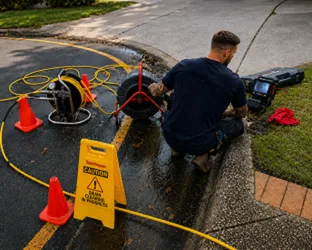
First job on site is stopping the damage: isolate, contain, make safe. Then you get a fixed price for the proper repair before it starts.

Most emergencies are permanently repaired on the spot. If a part has to wait for a supplier, you are left safe, watertight and functioning in the meantime.
Call and describe it. If it can hold, we will tell you, and book you at daytime rates. If it cannot, you will be glad you rang tonight.
Cost, response times, and what actually counts as an emergency.

Ring us and a plumber picks up. Leave details instead and you will get a callback with an ETA, not a sales call.

Leave your details and our local Erskineville team will call you back fast.